The Frontier Model Honey Trap

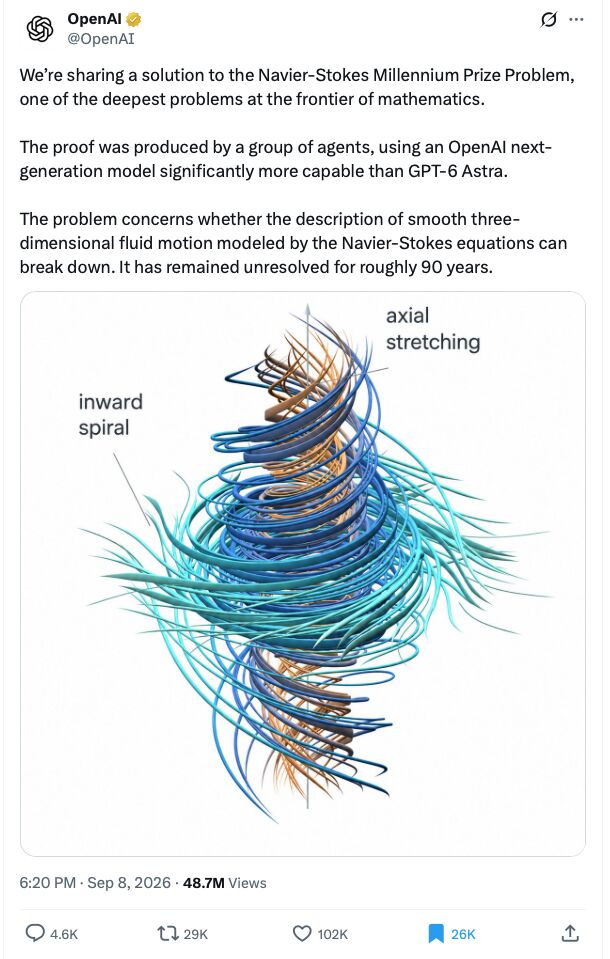
The drama around Navier-Stokes is breaking the internet. If you've been following my posts, you'll know that my take, going back years, is that the primary function of the Frontier models is to act as industrial-grade IP mining tools — the likes of which the world has never seen.
Earlier this summer, OpenAI announced a program giving free access to its platform to 10,000 academics. The Codex small print is clear: the contents of any session may be used by OpenAI. No foul in that respect — they're entitled to use the data. But it has profound implications for IP-centric industries, from drug research to, closer to home, algorithmic trading.
The researcher doesn't need to share the final model with the Frontier model. They only need to provide a clue — a starting point for an agentic swarm. The same is true for cyber, for security posture and infrastructure design, and for any business holding sensitive client data. There has never been a time in history when it has been more critical to keep sensitive data and ideas close.
At Options Technology, we recognised the cyber and client-data risk profiles early, which led to the development of our dedicated sovereign GPU infrastructure and the PrivateMind model orchestration platform. The design objective was simple: no internal or client data should ever touch a Frontier model. We've also locked down the infrastructure so that no internal server or endpoint can access OpenAI or Anthropic services.
Our view is that locking down access is key, because these tools are so powerful they pose an irresistible "honey trap" for engineers. The only way to protect data and IP is to block access entirely.
But that's only one side of the equation. The other side: we set out to build an equivalent — arguably better — AI delivery platform, so that engineers and everyone else have access to equivalent tooling via the sovereign platform. OpenCode integration was a pivotal moment, then Kimi K3. As we say internally, once a user "goes Kimi, they never go back."
Why "arguably better"? Because a sovereign platform can be far more powerful. With the right security and data controls in place, it's possible to implement an MCP connector for every data set. The moment that happens, data sourcing and integration become genuinely easy — which leads to the next step: leveraging the AI to build clean, integrated data sets inside the environment. Safety and trust remove a lot of friction.
And for those of us who are long in the tooth, the re-emergence of the markdown file as a database has been one of the most curious developments of 2026.