Open Models, Sealed Networks: Why Enterprise AI Value Is Moving Up the Stack

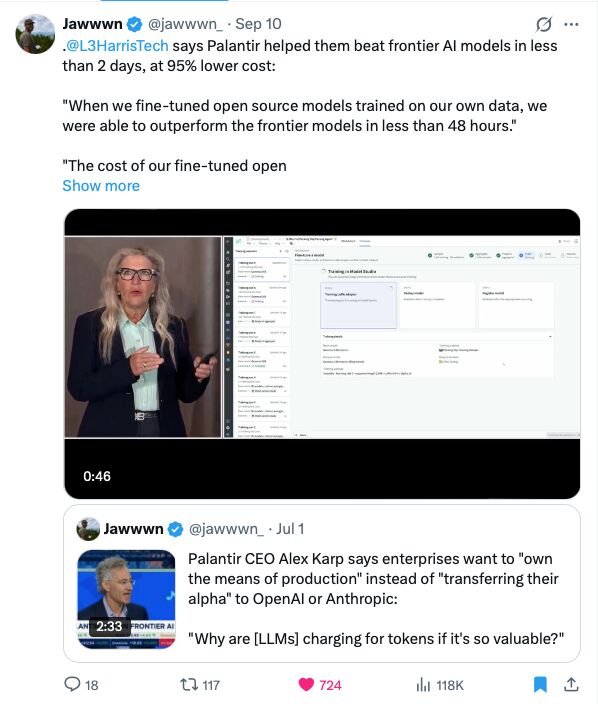
It's a good time to remind ourselves of Alex Karp and Palantir Technologies' experience with locked-down open models. It briefly made headlines in July before getting lost in the noise.
Trained open-source models are extremely efficient in production. They can run in hermetically sealed network segments with no internet access, all traffic monitored and data access permissioned — zero risk of a breakout.
This reflects our own experience running models in production at Options Technology. Once you figure it out, retraining is easy to automate. We run trained models that started from dirty data sets, with weekly retraining for the first few months (the iterative process cleans the data), then monthly thereafter. Tricky, but not a difficult problem to solve.
The gotcha for the frontier labs: not only does this approach solve the DLP, security, and compliance issues enterprises face, the trained models are extremely efficient to run — token costs of a few hundred dollars a month, single-digit percentage points of our total spend.
So what drives total spend? Leveraging the harness (in our case, OpenCode) to innovate and build the application in the first place.
That cost is dramatically lower with open models to start — a huge arbitrage on frontier-model token costs. It is also transient: any given enterprise has a finite need to build new apps.
The next stage in the evolution will be someone building a profiler for the harnesses. Game over for exponential token use. Does the frontier labs' enterprise model go poof?
The future is AI transformation, and the impact will be huge. Safety will not be a concern with well-thought-out architectures. The models themselves will be commodities, with the real value rapidly migrating up the stack to the AI application layer.